Real-Time CDP: What "Real Time" Really Means, and How to Test It
10 min read
Speed has become the main thing buyers ask a CDP for. In Adobe's 2026 CDP trends report, real-time performance was the top buying priority, cited by 69% of respondents. Yet only 27% were very confident their data warehouse could update profiles, qualify segments and serve the next-best experience in real time. (The report surveyed 150 CDP users and was sponsored by Adobe, so read it as a signal, not a census.) That gap, between wanting real time and being sure you have it, is what this guide is about. If you are new to CDPs, start with our plain-English guide to customer data platforms and come back.
Key takeaways
- A real-time CDP closes the loop from event to profile to segment to action while the customer is still in the moment.
- "Real time" covers three speeds: the same page (milliseconds), the same session or hour (streaming, seconds to minutes) and the next day (batch).
- Speed is only useful if the profile belongs to the right person. Identity resolution, deterministic and probabilistic, decides that.
- Vendor documentation is where the limits live: time windows, data that arrives in batches, and visitors who aren't yet known contacts.
- Fast detection doesn't mean instant sending. Some messages work better after a deliberate delay.
- Test the claim in a demo with your own events, and time it.
What is a real-time CDP?
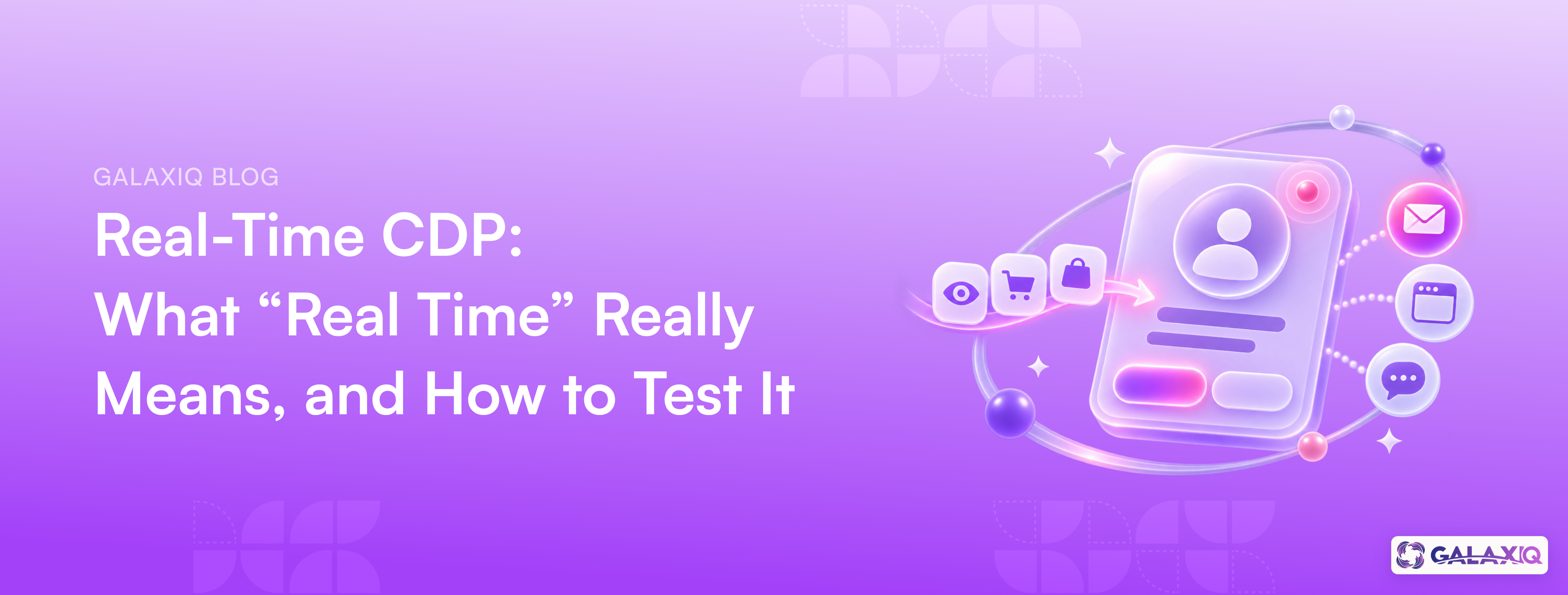
Every CDP builds one profile per customer from many sources. A real-time CDP also keeps that profile live. Someone views a product, adds to cart or chats with support. The event lands on their profile, their segments change, and the channels that use those segments find out straight away.
So the difference between a CDP and a real-time CDP isn't the database. It is the time between something happening and your marketing knowing about it.
Two jobs matter most:
- Unified customer profiles. The same person on your website, in your CRM and in your email tool is recognised as one customer. This is identity resolution.
- Live behavioural tracking. Clicks, views, carts and purchases are captured as they happen, rather than imported overnight.
Identity resolution: how a CDP knows it's the same person
A live profile is only useful if it belongs to the right person. Someone browses on their phone at lunch, opens your email on a laptop that evening and buys in store at the weekend. Unless those three records are joined, your "real-time" CDP is watching three strangers.
There are two ways to join them.
Deterministic matching links records when they share an exact identifier or meet an explicit rule. A loyalty ID, account ID, normalised email address or verified phone number is a strong signal that two records describe the same person, according to a 2026 identity resolution guide from CDP vendor Amperity. Its strength is that it can be explained: a data team can inspect the rule and see why two records were joined. Its weakness is that people don't stay tidy. They use personal, work and privacy-relay email addresses, move house, share household details and check out as guests, so exact rules can treat one customer as several.
Probabilistic matching estimates how likely it is that records belong to the same person by weighing several signals together, such as name similarity, address history, email patterns, phone numbers and device signals. The result is a score, and the business sets the threshold for accepting a match. It recovers links that exact rules miss, like spelling variations, incomplete records and changed details.
Both can go wrong in opposite directions. A false merge joins two different people. A missed match leaves one person split in two. Which mistake is worse depends on the job. Loose matching may be fine for measurement or ad suppression, but service, finance and anything regulated need stricter rules.
That is why most platforms use both. As the CDP.com glossary puts it, enterprises use deterministic matching first, and probabilistic matching only where reach matters more than certainty.
In real time, the stakes go up. A "returning shopper" segment only works if today's anonymous visit is linked to yesterday's known customer. And a false merge in real time doesn't sit quietly in a report: it sends the wrong person a message within minutes.
The three speeds behind "real time"
Adobe's own documentation is a useful map, because its Real-Time CDP offers all three speeds and says plainly which is which.
| Speed | How fast | What it's good for | How vendors describe it |
| Same page | Milliseconds | Changing the page someone is on, or the next one they load | Adobe: edge segmentation evaluates "instantaneously" for same-page and next-page personalisation. Salesforce: real-time segments build audiences in milliseconds. |
| Same session | Usually seconds to minutes | Triggered emails and SMS, suppressing ads after a purchase, alerting a sales rep | Adobe: streaming segmentation evaluates audiences in "near real-time". |
| Next day | Up to 24 hours | Weekly newsletters, lookalike audiences, reporting | Adobe: batch audiences are automatically evaluated every 24 hours. |
Sources: Adobe Segmentation Service overview, Adobe edge segmentation guide,
Salesforce Trailhead: real-time features in Data 360.
None of these speeds is wrong. The problem starts when a use case needs the first or second speed and quietly runs on the third.
Where "real time" quietly turns into "tomorrow"
The limits are rarely on the product page. They are in the documentation. Four examples:
Time windows. Adobe's streaming segmentation guide limits streaming rules to events within a 24-hour window. A rule such as "viewed this page in the last three days" isn't streamed. It is evaluated in batch.
Data that arrives in batches. Under Adobe's updated eligibility rules for upgraded streaming segmentation, a segment that uses batch-ingested profile data is evaluated in batch, not in streaming or on the edge. And an edge audience made only of profile attributes is evaluated daily. If your loyalty tier arrives from the CRM once a night, a "Gold members browsing now" segment can only be as fresh as that nightly file.
Simple rules only. Salesforce describes its sub-second layer as processing web and mobile events in real time, and says real-time rules are kept simple and event-based by design. Its own words: not all batch processing definitions will be handled in real time.
People who aren't contacts yet. HubSpot's workflow documentation says custom event triggers only enrol existing records. If a visitor triggers the event and becomes a contact a minute later, they aren't enrolled.
None of this makes these products bad. It means "real time" is a property of a specific rule, built on specific data, sent to a specific channel. Not of a whole platform.
Fast isn't the same as right
Knowing about an event in a second doesn't mean you should act in a second. Klaviyo's browse abandonment guidance recommends waiting at least an hour before the first message. It also suggests a lighter touch than a cart reminder, because viewing a product
shows less intent than starting checkout.
The value of real time is in the decision, not the send. A live profile lets you:
Personalise the session that's happening now, such as showing a returning visitor the category they browsed last time instead of the generic homepage.
Stop at the right moment. Remove a customer from a discount journey, or a retargeting audience, the minute they buy. Batch data keeps paying to chase people who have already converted.
Trigger the follow-up while intent is fresh, then wait as long as the message needs.
Give support context. An agent or chatbot can see what the customer did five minutes ago, not yesterday.
For a worked example of the timing, see our browse abandonment test across six platforms.
Why this matters more in 2026
Two things have changed this year.
First, CDPs now feed AI agents as well as marketers. In June 2026, BlueConic acquired Blueshift, framing the deal around giving AI agents the real-time behavioural context they need to decide and act. In October, Cordial launched a headless CDP so marketers can
explore real-time customer data from Claude, ChatGPT or Microsoft Copilot. An agent working from yesterday's profile makes yesterday's decisions.
Second, value is still hard to reach. In the CDP Institute's 2024 member survey, 68% of respondents had a deployed CDP. But users said only 64% of deployed CDPs were returning significant value, and that figure has been falling. Buying the label doesn't buy the outcome.
A note for Australian teams. From 10 December 2026, organisations covered by the Privacy Act must disclose in their privacy policy when a computer program makes or informs decisions that significantly affect people (OAIC). Most real-time marketing won't meet that bar, but Allens' reading of the OAIC guidance is that targeted content or advertising may be captured if it results in personalised pricing. If your segments change prices or access to significant services, check with your privacy team. This isn't legal advice.
Five questions to test any real-time CDP
Ask these in the demo, using your own events where you can.
- "Show me an event landing on a profile, and time it." Fire a test page view or add-to-cart. How many seconds until it appears on the profile, and until the person joins a segment?
- "Which of my segments will run in real time, and which in batch?" Bring three real segment ideas. Ask which speed each would run at and why.
- "How do you match identities, and what happens to an anonymous visitor?" Which matches are exact and which are scored? Can you see why two records were joined, and undo a bad merge? When an anonymous visitor identifies themselves, does their earlier behaviour join their profile?
- "How fast does someone leave a segment?" Joining quickly is half the job. After a purchase, how soon do they stop getting the discount email or the retargeting ad?
- "Which channels act on the segment directly?" For each channel, is it a live connection, an hourly sync or a daily export? And how are consent and opt-outs carried with the profile?
How GalaxiQ handles real-time CDP
GalaxiQ's real-time CDP is EdgeIQ, the customer data platform at the centre of GalaxiQ's AI marketing platform. Here's how it works:
- Real-time event tracking: every visit, click, cart and purchase is captured as it happens and added to one profile per customer.
- A live view of each customer: search any user ID to see their sessions, page views, cart value, live activity feed and every segment they currently belong to.
- AI segmentation: Atlas, EdgeIQ's AI, turns events into ready audiences such as High Value Customers and Returning Shoppers, with estimated reach and confidence scores, and keeps refining them as behaviour changes.
- Architect Agent: keeps mapping each customer to the segments that fit them as they act, so segment membership moves with behaviour instead of waiting for a rebuild. It also runs identity resolution, using deterministic matching where records share an identifier and probabilistic matching where they don't.
- Journeys from a prompt: describe the goal in plain English, and EdgeIQ designs the journey and picks the channel for each step, including email, onsite popup, SMS and video.
- One data hub: web tracking, your CRM, customer imports and other GalaxiQ products connect in one place, so the profile doesn't become another silo.
The two jobs depend on each other. Identity resolution decides whose profile an event belongs to, and the Architect Agent decides which segments that profile belongs in. Because the same platform holds the profile, the segment, the content and the send, an event doesn't have to travel through exports between separate tools before something happens.
Now the cautious part. GalaxiQ was founded in Sydney in 2025, so it has a shorter track record than Adobe, Salesforce or HubSpot. Email and SMS still need a known customer who has agreed to hear from you. And you shouldn't take speed claims from any vendor on trust, ours included. Ask us to run the five questions above on your own website.
How the platforms compare
Based on each vendor's own documentation, checked 18 November 2026.
| Platform | Fastest documented speed | Where it slows down | What acts on the segment |
| Adobe Real-Time CDP | Edge segmentation, "instantaneously", for same-page and next-page use | Streaming rules limited to 24-hour windows; batch-ingested data is evaluated in batch | Adobe Target and Journey Optimizer, plus destinations |
| Salesforce Data 360 | Real-time segments built in milliseconds | Sub-second layer covers web and mobile events; real-time rules must be simple and event-based | Salesforce Flow and other Salesforce apps, plus external systems |
| HubSpot | Workflows enrolled by events and page views (no speed stated in the docs we checked) | Custom event triggers only enrol existing contacts | HubSpot workflows |
| GalaxiQ (EdgeIQ) | Events captured as they happen; Architect Agent re-maps customers to segments continuously | Newer platform; known contact and consent needed for email and SMS | EdgeIQ journeys across email, onsite popup, SMS and video |
Frequently asked questions
A customer data platform that updates each customer's profile and segment membership as they act, so marketing can respond during the same visit or session rather than the next day.